
Charlotte County Wanted Channels
Two official channels carry Charlotte County's wanted features. The sheriff's office app includes a most wanted section, and its news blog publishes individual wanted notices along with capture updates. Neither comes with promises. The list has no fixed length, photos are not guaranteed, and postings follow no schedule. Private websites love to invent headcounts and update claims. Ignore those numbers; they are fiction dressed up as sheriff policy.
A wanted post is a spotlight, not an index. Law enforcement chooses who gets highlighted, and plenty of warrants never earn that attention. Old posts can also linger after someone has been arrested, surrendered, or had the warrant recalled. For the current status of any name, go straight to the sheriff, the issuing court, or an attorney.
Know your errand before you start. Browsing for recognition belongs on the app or agency posts. Digging into one named subject belongs in the formal CCSO inquiry. And a name absent from the wanted material means nothing either way.
Charlotte County Wanted Details
Every notice is its own animal. CCSO publishes no fixed template, so read only what the post actually shows. A missing photo, height, caution flag, or last-known location signals nothing. The public version is often selective by design. Investigators may hold details back on purpose.
| Possible item | How to read it |
|---|---|
| Name or identifying details | Use the spelling and details in the current official notice, then guard against a same-name mismatch. |
| Image | A photo may appear in a selected notice, but the app announcement does not guarantee images for every entry. |
| Warrant or alleged offense | It states why authorities seek the person. It does not establish guilt or the final filed charge. |
| Agency instructions | Follow the stated tip channel and warning. Do not act beyond observing and reporting. |
| Post or update date | Use it to judge age, then seek current confirmation because warrant status can change. |
Pair every notice date with its source. Check for follow-up, too. The sheriff's blog has carried both wanted notices and capture reports; a 2024 post, for instance, announced that someone from the county's most wanted had been located and arrested. One stale entry proves nothing about today.
Use Charlotte County Most Wanted
The wanted channel serves two purposes: recognition and reporting. That is all. Keep the source and date attached to every claim, and stay alert to mistaken identity when a face looks familiar.
- Open the official Charlotte County Sheriff app or a selected notice on the CCSO Blog.
- Read the full notice, including the date, identifiers, alleged warrant basis, and any safety instructions that are actually displayed.
- Compare identifying details cautiously. Do not publish a guess, contact the person, follow them, or try to confirm an address.
- Send nonurgent information through CCSO or Southwest Florida Crime Stoppers. Call 911 only for immediate danger.
- After a reported capture, use the Charlotte County arrest and booking sources and then the Clerk docket to follow the official record.
A capture changes the paper trail. The booking record documents the custody event, and the court file takes over from there. Counts can change. Cases can end in dismissal, a plea, or a trial result.
Note: Never approach, confront, follow, or try to detain anyone shown in a Charlotte County wanted notice.
Check Charlotte County Warrants
Need a verified answer? Use the CCSO warrant inquiry form. Understand what it is: a request, not an instant search. The form asks for your first and last name, phone, and email. It also wants the subject's name, date of birth, and your reason for asking.
- Gather the subject's complete name and date of birth so CCSO can distinguish people with similar names.
- Complete the requester fields and explain the reason for the inquiry truthfully.
- Submit the official form and retain any confirmation supplied by the agency.
- Allow up to seven business days, excluding weekends and holidays. CCSO says it is under no obligation to provide warrant information.
- If the matter may concern the requester, contact an attorney, the issuing court, or law enforcement for a safe way to resolve it.
CCSO rejects incomplete or falsified requests. Fill in every field with care. The agency also runs an official Warrants page, though its body does not clearly offer a live public search. A blank result from an unclear interface proves nothing about whether a warrant exists. The official warrant inquiry page shows the agency-run request channel and where its limits sit.
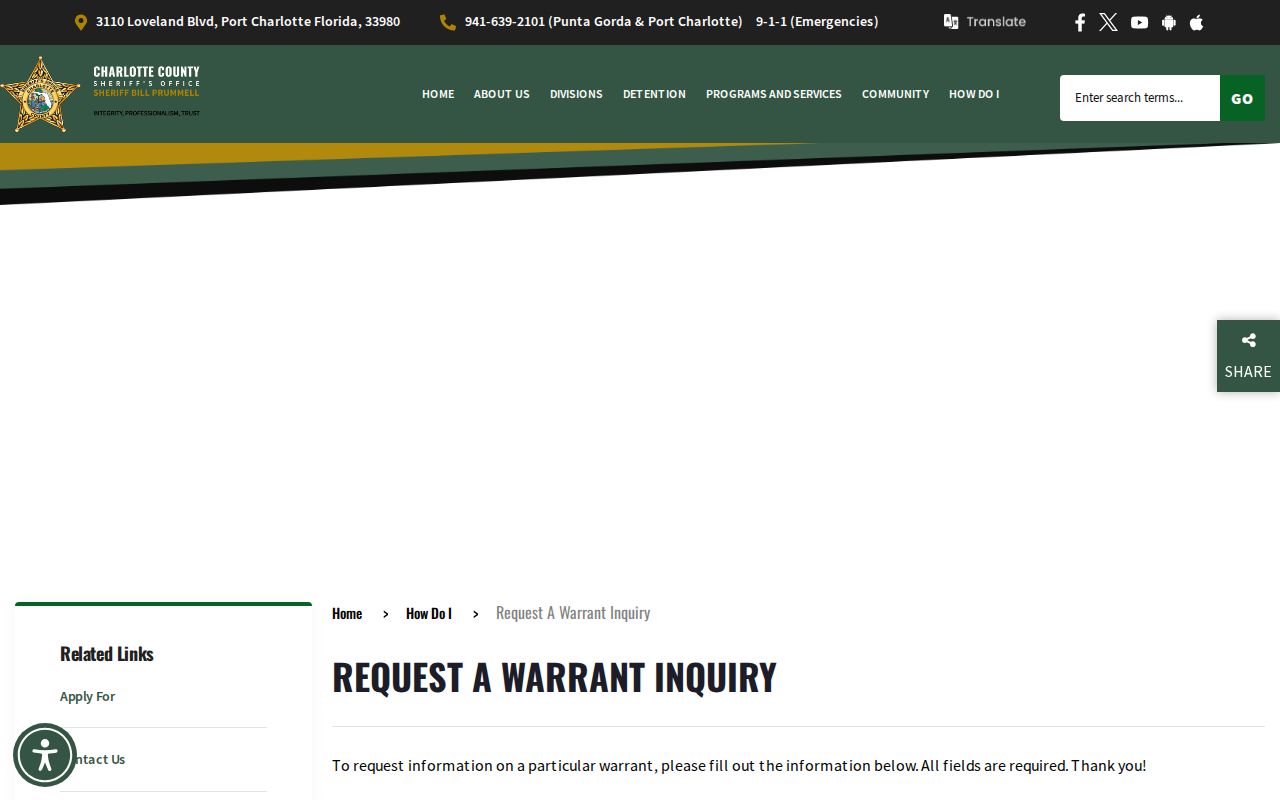
Delays and agency discretion separate this inquiry from a live wanted list or an instant commercial name search. The sheriff controls what comes back and when.
Charlotte County Warrant Types
Public sources toss around several warrant labels. The label helps route your question. Still, only the issuing record shows the current terms. Remember what a warrant actually is: a judicial authorization tied to a case or a court obligation.
| Term | What it generally signals | Best next source |
|---|---|---|
| Arrest warrant | Judicial authority to arrest based on an alleged offense. | CCSO inquiry, issuing court, or counsel. |
| Bench warrant | A court-issued warrant tied to a missed appearance or unmet court direction. | Charlotte Clerk case docket and the issuing court. |
| Capias | A court command directing that a named person be taken into custody. | Clerk docket, court, or counsel. |
| Out-of-county warrant | A warrant originating in another Florida county or jurisdiction. | The issuing agency or court identified in the record. |
The Charlotte Clerk Court Search can surface a docketed warrant event when a case is public. Not every active warrant appears there, so never treat it as complete. Search by name, case number, or citation number. Match identities with care. When you need the outcome nailed down, request a certified disposition.
Charlotte County Wanted Tips
Tips travel through the official crime-tip form. CCSO says the personal-information fields can stay blank for an anonymous report. The sheriff's app also carries a submit-tip button. One rule never bends: call 911 for immediate danger.
Southwest Florida Crime Stoppers
Tip line: 1-800-780-TIPS (8477)
Availability: Staffed around the clock, every day of the year
Other methods: online submission or the P3 Tips app
Anonymity: Callers stay nameless; no caller ID is used and calls are not recorded, per the program's own notices
Reward: Up to $3,000 is possible, though never guaranteed
Stick to facts on the call. Where and when you saw the person, a safe physical description, any vehicle details, and how you came to see it: that is what helps. Leave the rest alone. Do not trespass, chase down more proof, or name someone online. Never risk yourself or others to strengthen a tip. The tip line takes it from there.
Resolve Charlotte County Warrants
Suspect a Charlotte County warrant has your name on it? Skip the rumors. Skip the unofficial search sites too. Talk to a Florida attorney, the issuing court, or law enforcement about the lawful path forward. A lawyer can pull the case, confirm which authority issued the warrant, and guide your response without piling on risk. No web page can guarantee any outcome, whether that means release, a first appearance, bond, or another court step.
The Charlotte County Clerk criminal division handles felony, misdemeanor, criminal traffic, and county or municipal ordinance cases. Its public docket may show filings and later action. Paperwork can lag behind an arrest by days. A blank search proves little. A warrant entry on screen might be stale. Read the newest docket activity and confirm directly before drawing conclusions.
- Warrant
- A judicial authorization to take a person into custody or require action in a case.
- Booking
- The jail intake process that records a custody event after arrest.
- First appearance
- The early court hearing for a detained person, including rights and release conditions.
- Disposition
- The court record of how a filed charge or case ended.
Each tool answers a different question. A wanted notice asks the public for tips. A warrant inquiry digs into agency records. A jail entry tells you who is in custody right now. The court docket is where the case itself moves forward. Keep these four straight and you will read each one the right way, rather than mistaking an old wanted post for present status.