
Charlotte Busted Mugshot Records
A busted record in Charlotte County begins at the jail door. Deputies or local police bring someone in. Staff confirm who the person is and open a booking file. Inside that file sits a booking number, the charges, fingerprints, and a booking photograph. Most people call that photo a mugshot. Its job is simple: identify the person in custody. Nothing else.
Two agencies feed the county booking record. The Charlotte County Sheriff's Office runs the jail and builds the main file. Punta Gorda Police write their own incident reports, but their arrests land in the same system. Florida leans toward open records. Even so, exemptions can shield parts of a file, and the online portal may show less than the agency holds. A name or a face alone makes a weak match. Before you conclude anything, check the booking date, the booking number, the arresting agency, and the court case.
Charlotte County Booking Fields
Florida's records schedule lists what a booking file can hold. It promises nothing about the live Charlotte County arrest portal. So treat any online result as a first look only. When a detail truly matters, ask the agency for the full releasable record. The Sheriff's Office should also explain the basis for any redaction or withheld item.
| Field | What it can establish |
|---|---|
| Identity and aliases | The name tied to intake, with demographic details used only to distinguish similar names. |
| Booking number and time | The unique jail event and when intake was recorded. |
| Arrest details | The arresting agency, officer, date, time, location, and agency case number when releasable. |
| Booked charges | The charges recorded at intake, which may differ from counts later filed in court. |
| Bond or hold | The release condition or reason custody continued at that point in time. |
| Custody and release | The facility status, release date, and release method when those fields are public. |
| Booking photograph | The intake image, if created and releasable. Online display is not verified. |
Booking is only half the story. The court file picks up from there. Expect a case number, filed counts, hearings, orders, plea or trial activity, adjudication, sentence, dismissal, acquittal, and closure status. Counts filed in court can differ from the original booking text. Need the final result? Order a certified disposition from the Charlotte County Clerk.
Charlotte Busted Record Requests
What if the Charlotte County Local Arrest Database lacks the record or photo you want? Then go straight to the source and follow the sheriff's public-records instructions. A narrow request beats a broad one. Include the full name, a rough arrest or booking date, the booking number if you have it, and the exact record types you need. Ask for electronic delivery too. Spell out the items: the releasable booking record, booked charges, bond or hold, arresting agency, release details, and the booking photograph.
- Confirm the person's name and approximate Charlotte County booking date in an official source.
- Submit the request through JustFOIA or send it to the CCSO public-records custodian.
- Ask for an estimate before the office incurs costs and request the legal basis for each redaction or denial.
- Match the returned booking number to the Charlotte Clerk criminal case and final disposition.
CCSO posts no flat fee for booking photos. No fixed completion date exists either. Florida law does require prompt acknowledgment and a good-faith response, though agencies get reasonable time to search and redact. Plan on general paper-copy rates, actual media cost, or a special service charge when the work runs long. You can inspect records at the current administrative office, 8 a.m. to 5 p.m.
Charlotte County Sheriff's OfficeAttn: Custodian of Public Records
3110 Loveland Boulevard
Port Charlotte, FL 33980
941-639-2101
Inspection: 8 a.m.-5 p.m.
The captured official CCSO records page confirms the current request route and custodian details.
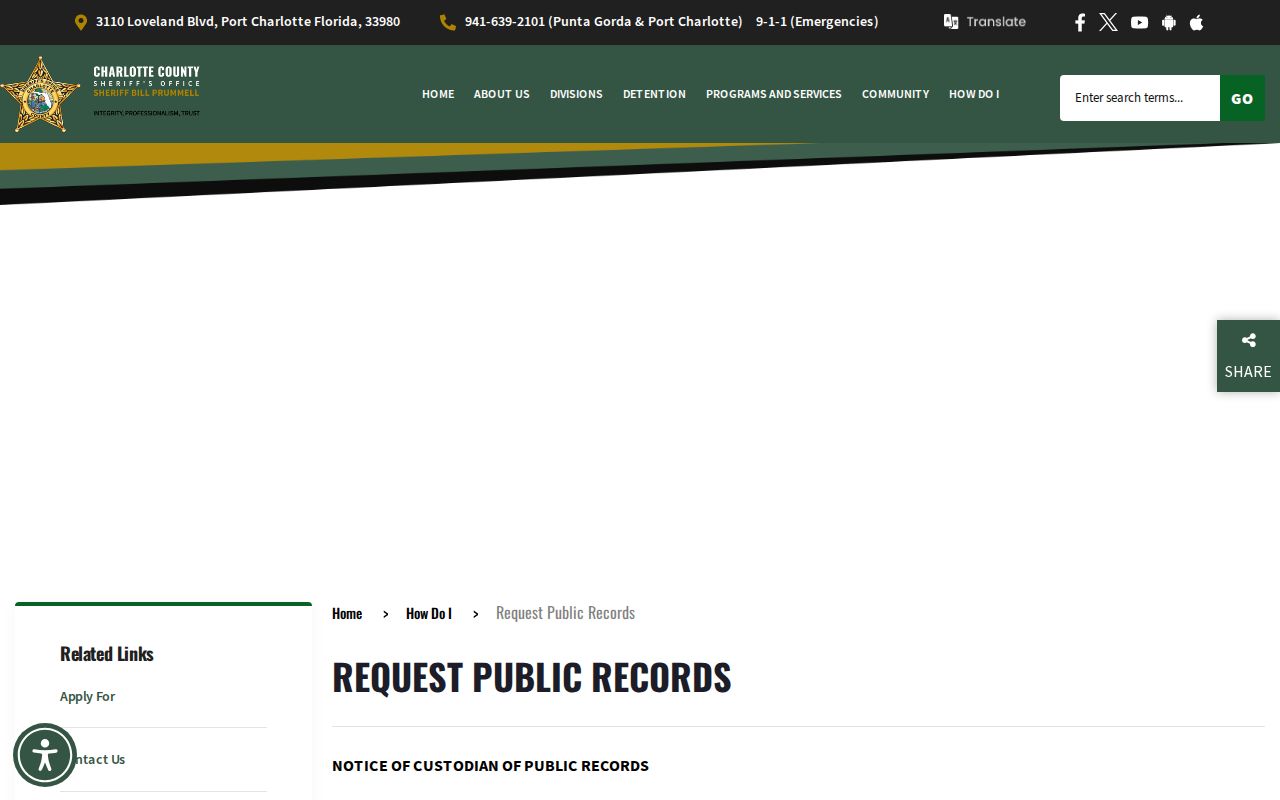
For a released entry, an online photo you can't verify, or anything needing a written agency response, the official page is the fallback.
Charlotte Busted Mugshot Law
Florida's Constitution and chapter 119 set the public-records baseline. That baseline does not force every Charlotte County booking photo to stay online forever. Nor does it make every field public. Exempt data can be redacted, and confidential records can be withheld. A correction request to CCSO fixes an official error. Sealing or expunction runs through the separate FDLE and court process. Neither path equals asking a private publisher to update its copy.
One state law aims straight at commercial booking-photo publishers. Follow the sheriff's channel for agency errors, but Florida Statute § 901.43 works on publishers instead. A person shown in an image, or a legal representative, can send the publisher's registered agent a registered-mail request with enough identifying detail. When the statute applies, removal must be free and must finish within ten calendar days. The publisher cannot charge a fee or republish the image. The law has a defined commercial scope, so it doesn't reach every news outlet or public agency. The official statute page controls the covered-publisher process and its remedies.
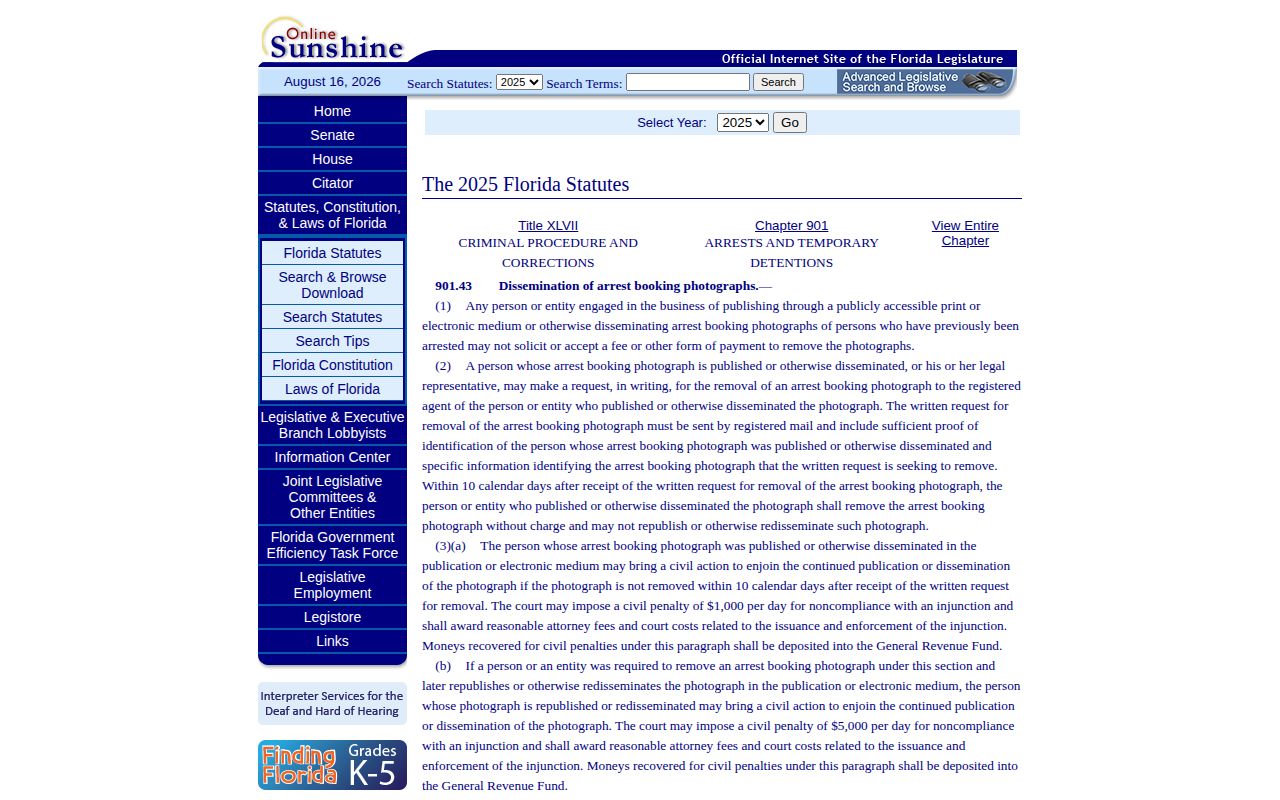
Read the statute before you send anything. Florida law demands specifics in a takedown notice. You must name the legal entity, the registered agent, the delivery method, and the exact image. Miss one of those pieces and the notice likely fails.
Private sites handle removals in different ways. RecentlyBooked and Mugshots.com both post no-fee record-maintenance policies. Busted Newspaper and Mugshots.zone offer request forms instead. Neither page, though, promises that every request comes free. Arrests.org shows no verified removal policy anywhere. Skip paid scrubbing services too. Official relief, § 901.43 where it applies, and a publisher's own no-fee process can achieve the same result without any cost. Once a source updates, a search engine's stale-content tool can refresh its cached copy. One limit stands: that tool can't seal a court file or wipe an agency record.
Charlotte Juvenile Booking Privacy
Florida treats juvenile confidentiality as a conditional shield. Sections 985.04 and 985.11 protect juvenile records, photos, and fingerprints in most cases. Yet the statutes carve out felony-related and other exceptions. So when a Charlotte County juvenile booking image is missing, treat that omission as official. Don't fill the gap with gossip, social media, or an unofficial mirror site. Ask the proper custodian whether any releasable record exists.
Juvenile court files follow different rules than adult ones. Access can hinge on age, case category, the date of the last entry, and whatever statutory exception applies. Finding an image on a third-party site proves nothing about whether its publication is lawful now, or whether the file is even current. Something being findable elsewhere is never a reason to rehost it.
Note: A protected Charlotte County record should be handled through the agency or court, never reconstructed from an unofficial source.
Charlotte Busted Sealing Gaps
Florida lets people clear a record two ways: sealing or expunction. The typical path runs through an FDLE eligibility review first, backed by certified Charlotte County court papers, then a petition filed with the court. That FDLE certificate is a milestone, not a victory. Judges keep discretion the whole way. Plan on about twelve weeks for the FDLE review. No fee buys speed, and the certificate expires after twelve months. Whether a case qualifies turns on the charge, how it ended, prior history, whether supervision wrapped up, and a stack of statutory limits.
Automatic sealing hides FDLE and Clerk copies. It cannot compel every other criminal-justice agency to lock up its own. So one search can contradict another. A Charlotte Clerk lookup, an FDLE history, the CCSO database, and some private mirror site may each tell a different story about the same person. Expunction digs deeper, ordering local copies destroyed or obliterated, though FDLE retains a confidential copy under statutory exceptions. And a record that vanishes from the web proves neither form of relief was granted.
Charlotte Booking Archive Split
Florida's GS2 schedule sets floors for how long records survive, not ceilings on what a website shows. Booking records, commitment and release lists, and inmate incarceration records must be kept at least one anniversary year past release. Jail docket books never get thrown away. Agencies can also hang onto material well past the minimum. That gap is why a name may vanish from the public Charlotte County roster while the booking record, a permanent docket entry, and a Clerk case file all live on.
Chasing an older arrest? Ask CCSO for that specific booking record and its photograph, and learn whether the agency still holds it, disposed of it under schedule, or shipped it elsewhere. Check the Clerk docket as well. Order the certified disposition while you're at it. The State Archives of Florida helps researchers locate transferred historical holdings, not fresh arrests. Even with no digital photo left, a permanent docket still proves the booking happened.
Find Charlotte Busted Mugshots
Custody status comes first. Then pick the right source. Someone freshly booked or held at the Charlotte County Jail belongs to the CCSO channel. Once released, that person may require a formal records request instead. Florida state prison inmates appear in the Department of Corrections search, while federal prisoners belong in the federal locator. Civil immigration detention runs through its own ICE locator. For the court outcome itself, go to the Charlotte Clerk, never a custody list.
- Open the official CCSO Local Arrest Database for a recent local booking or current jail search.
- Use the sheriff app's recent-arrests feature if the embedded site will not load, but do not assume its photo coverage or date window.
- Call Charlotte County Jail when current physical custody must be confirmed, or use VINELink for eligible custody and release notices.
- Request a released or missing booking record and photograph from CCSO with a narrow date and identity match.
- Check the Charlotte Clerk criminal docket for filed counts and final disposition.
- Move to FDC, BOP, or ICE only when that later custody system fits the person's status.
Match on details, not on a face. Before drawing any conclusion, compare the full name, booking date, booking number, arresting agency, and court case number. A photo alone proves nothing about identity. When official channels disagree, note the source and the date you accessed it, then take the question to the record custodian. Timing plays tricks too. A social post or news story can beat intake or any court filing into public view, and a release can land before the next roster check happens.
Charlotte Busted Jail Roster
The CCSO Local Arrest Database is the county's go-to source for inmate lookups and recent arrests alike. It embeds the county bookings interface straight into the page. When that panel won't load, open the underlying source through the official page instead. Stick to whatever controls the live screen actually gives you. Plenty of results arrive without a photograph. Treat a mugshot as a bonus, not a guarantee.
| Search detail | How to use it | Limit |
|---|---|---|
| Name | Enter the most exact spelling the live form allows. | Similar names require another identifier. |
| Date | Use a known arrest or booking date if the control appears. | No fixed public date window is verified. |
| Booking number | Save it from a matching result and cite it in a request. | Availability as a search input is unverified. |
| Agency and case | Compare displayed details with the court docket. | Portal display may be narrower than the full file. |
CCSO posts no refresh schedule and no rule for how long a released entry stays up. A blank result can mean intake lag, site maintenance, a release, confidentiality, a misspelled name, or the wrong jurisdiction entirely. Need current custody confirmed fast? Call the Charlotte County Jail at 941-833-6300. When the portal shows no booking photo, request the releasable photograph directly from the agency. The official roster wrapper names the county source without reproducing anyone's booking photo.
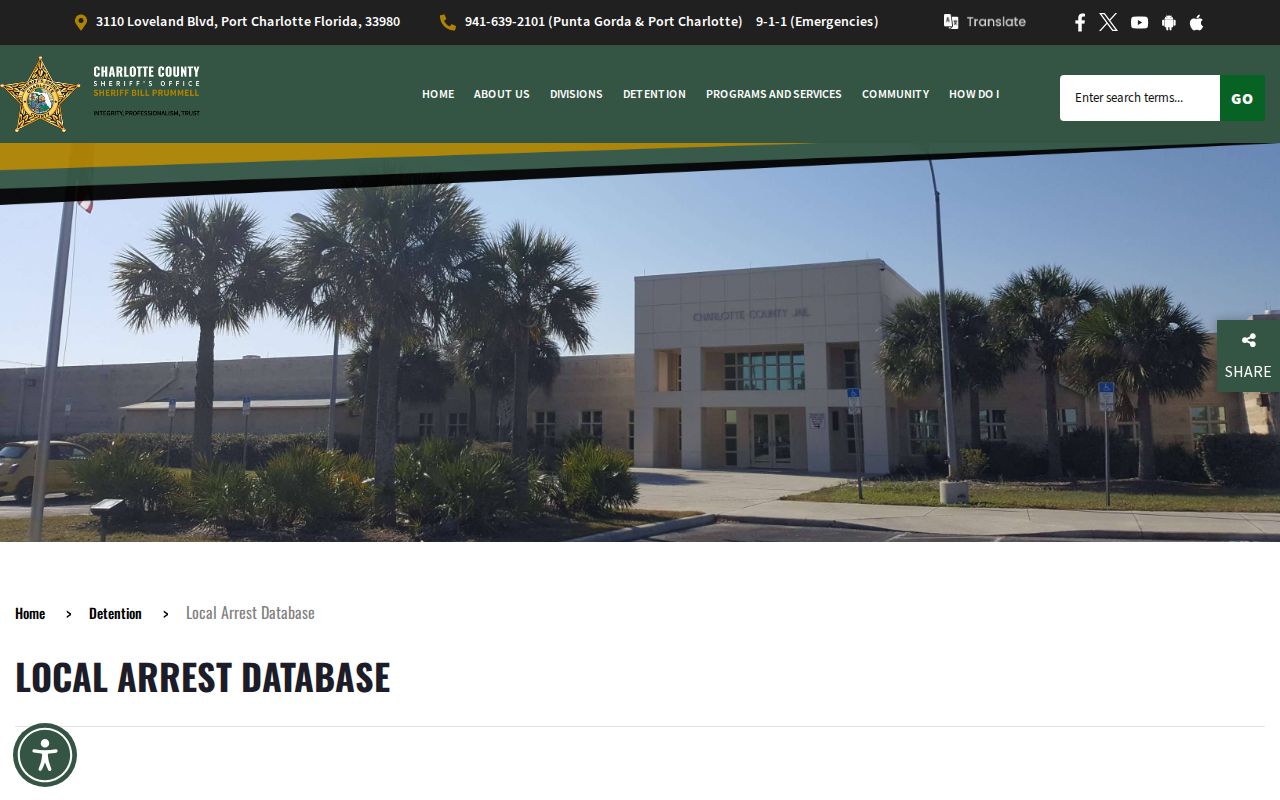
This neutral interface leaves the actual searching to CCSO, and it keeps Charlotte County arrest records from turning into a photo gallery.
Charlotte Booking Feed Limits
Charlotte County runs no official page limited to the last 24, 48, or 72 hours. No weekly booking blotter exists. No guaranteed web archive either. Same-day or multi-day, the question is the same: use the Local Arrest Database. Allow processing time, then try the official app. Still no result? Call the jail about present custody or file a CCSO record request.
The Punta Gorda Daily Reports and Event Search is a city police event system, not a verified county booking feed. Its window, fields, update rate, and photo behavior all remain unconfirmed. Treat any private site's 30-day label as that site's own claim rather than CCSO policy. Weekend arrest volume can slow processing. Nobody local has ever promised a surge or a guaranteed Monday update.
Charlotte Busted Sheriff App
Keep the official Charlotte County Sheriff app on your phone as a backup. It lists recent arrests beside the county most wanted list. The extras go further: crime tips, public-safety notices, traffic and active-scene alerts, news, events, and nearby registered-offender information. When the embedded database on this page stalls, the app often still delivers. Be realistic about its limits, though. The agency's announcement says nothing firm about booking photos on arrest cards, how long entries stay up, or how often the data refreshes.
The CCSO app announcement points to listings for both iOS and Android. Features can shift between versions. Treat it as an aid, not an authority. Verify the booking number, current custody, and any court case through the proper source. The Clerk's disposition record still has the final word on what a case became.
Note: The sheriff app is an official alternate channel, but its booking-photo coverage and recent-arrest window remain unverified.
Charlotte Intake Booking Timeline
The CCSO inmate handout lays out Charlotte County's intake sequence. Most people arrested here go to Charlotte County Jail. Processing and a first appearance follow, though stated exceptions exist. U.S. Marshal holds, parole violations, and civil actions fall outside the normal path. Bond out or win release at first appearance, and housed custody may last only hours. Otherwise the person gets classified and housed.
Timing explains a lot of confusion. A police event, a completed booking, a live jail result, and a Clerk case can each surface at different moments. Florida's first-appearance rule generally brings anyone still lawfully detained before a judicial officer within 24 hours. Counsel, communication, and release conditions all get addressed at that hearing.
Charlotte Busted Bail Branch
The county's online monetary bail schedule carries genuine weight. One catch, though. The version on file took effect in 2014, so read it as an illustration of how local bail works rather than today's operative order. The booking path it sketches still holds true. Certain scheduled charges let the sheriff release a person directly, while other categories demand a first appearance before a judge sets the terms.
Numbers on a schedule never settle release by themselves. Actual conditions come from the current court order on the case, and a hold can block release even with a bond amount listed. For an answer that counts, check the live docket with the Clerk. Then confirm custody straight with the jail.
Charlotte Busted Court Outcomes
Don't hunt for case outcomes in the Official Records recorder. That side of the Clerk's office handles deeds and filings. Criminal results live in the Charlotte Clerk Court Search. Its criminal division spans felonies, misdemeanors, criminal traffic, and county or municipal ordinance matters. Name, case number, or citation number all work as search terms. Match identifiers against the booking before connecting anything, and give filings a few days to catch up with the arrest.
The court record is what settles things. Prosecutors may file different counts, amend charges, decline to file, or dismiss outright. Later entries can show a plea, a verdict, a sentence, or simple closure. When the exact outcome matters, order a certified disposition. A short docket label won't carry that weight.
- Booking
- Jail intake after arrest.
- First appearance
- The early court review for a person who remains detained.
- Bond
- A condition that may permit release while the case is pending.
- Disposition
- The court's recorded outcome of a charge or case.
- Expunction
- Court-ordered relief that affects eligible records under Florida law.
Charlotte Custody Record Paths
Where a person sits determines which record to pull. Someone currently held in the Charlotte County Jail appears through the CCSO inmate database or the jail's phone line. After release, the web view may drop the name, but the booking record itself stays available on request.
State custody works differently. Anyone serving a Florida prison sentence or living under state supervision may show up in the FDC Inmate Search, sometimes with a photo attached. That image comes from state corrections. It reflects a later status, not the original county booking picture.
Just booked: Check CCSO first. Expect some intake lag before the name posts.
Held in the county jail: Check CCSO, then call 941-833-6300 for live confirmation.
Released: Request the booking file and pull the Clerk docket.
State sentence or supervision: Search FDC by exact name or DC number.
Federal sentence: Use the BOP locator. It is not a public mugshot gallery.
Immigration detention: Use ICE's civil custody locator, not a criminal booking feed.
Not every custody situation runs through the county. A federal pretrial detainee might occupy a local bed under a U.S. Marshals Service contract, so the holding facility and the prosecuting court can sit in two different places. ICE detention works differently. That track runs on the civil side. Whatever the route, the court with jurisdiction decides the legal outcome.
Charlotte Victim Booking Alerts
VINELink answers a different question than a mugshot lookup. Enrolled users get custody and release notifications when eligible. It is not a source for booked charges or case outcomes. Alert Charlotte, meanwhile, covers emergencies and active incidents, not jail bookings. Mixing up the two products is a common mistake. An incident alert is not a booking record.
The sheriff's office has pushed further. In July 2026 it announced an end-to-end victim notification initiative built on VINE and Versaterm CommunityConnect, designed to keep people informed across every stage of a case. Current program materials govern who qualifies and what each alert contains. Push notices in the sheriff app cover public-safety events only. Read them as updates on what's happening, not as automatic custody changes.
Charlotte Busted Office Locations
Skip the old Utilities Road lobby. CCSO shut that one down in 2026 and moved its public administrative office to 3110 Loveland Boulevard in Port Charlotte. The jail never moved. Charlotte County Jail still sits at 26601 Airport Road in Punta Gorda, and the number for inmate or booking questions is 941-833-6300.
Picking the right building matters. Sheriff records requests go through the Loveland Boulevard office or its online portal. Custody questions belong at Airport Road. Court and case questions should go to the Charlotte Clerk criminal division at the Justice Center. Watch out for stale directories that still print the closed address, and confirm before you drive over.
Note: CCSO administration and Charlotte County Jail have different addresses, phones, and public functions.
Charlotte Mugshot Source Landscape
Every official source answers a different question. CCSO handles county custody and booking. PGPD covers incidents inside Punta Gorda city limits. The Clerk's office tracks a case to its end, FDC handles state corrections, and federal agencies maintain their own records. News sites and private publishers can help you nail down a date or an agency. Their copy can lag, though. A release, dismissal, sealing, or later court action may not show up right away.
| Channel | Photo status | Authority and use |
|---|---|---|
| CCSO Local Arrest Database | Online display unverified | Official county arrest and inmate source. |
| CCSO records request | Ask for the releasable photo | Official fallback for a specific booking file. |
| Charlotte Clerk | Not a mugshot feed | Official filed counts and disposition source. |
| FDC offender search | Profiles may show an offender photo | Official state prison or supervision source, not county intake. |
| Local and regional news | Varies by selected story | Editorial coverage, not a complete custody list. |
| Private county pages | Often prominent images | Unofficial leads that require CCSO and Clerk verification. |
Plenty of private sites post Charlotte County booking photos. The county-local options include Busted Newspaper, RecentlyBooked, Mugshots.com, Arrests.org, and Mugshots.zone/. None of them is official. RecentlyBooked claims a 30-day view refreshed several times daily, though that schedule is its own claim rather than sheriff policy. Mugshots.com leans archival. Arrests.org and Mugshots.zone rotate records and post accuracy warnings. Whatever turns up, check it against CCSO and the Clerk before you trust it.
Local news adds another layer. Charlotte Sun, through YourSun, runs a recurring Police Beat built on agency reports, mostly text rather than a standing photo gallery. Gulf Coast News Now, WINK News, and Fox 4 Southwest Florida cover selected arrests. CCSO Blog and PGPD News sit upstream as the official channels feeding many of these stories. None is a full booking feed, and stories sometimes reuse older images. For broader reporting context, see Mugshots in the News.
Charlotte Busted Mugshots by City
Punta Gorda is the county seat and the county's only incorporated city. Its police department works inside city limits. CCSO holds countywide authority and mostly covers unincorporated areas like Port Charlotte, which has no city police force of its own. One PGPD incident can touch three official records, so plan on checking the city event or report, the CCSO jail booking, and the Clerk court case separately.
Punta Gorda Busted Mugshots walks through each path: the city event search, the PGPD records request, county jail intake, and the local news angle. Punta Gorda arrestees processed locally all pass through Charlotte County Jail, with documented exceptions. A city police report and a county booking each show a different piece of the picture.
Who holds a Punta Gorda arrest photo? PGPD keeps its incident and agency material. CCSO holds the county booking record and any releasable booking photograph taken after jail intake. The Clerk holds the case outcome.